Blood/Water collision with Wall
(Computational Fluid Dynamics class)
Skills
CFD Fluent
Objective
My objective was to perform a CFD Fluent analysis using the Volume of Fraction model to analyze the similarities and differences between a water and blood droplet collision
Process
I set up a transient multiphase CFD model in ANSYS Fluent to simulate droplet formation, travel, and wall impact using the Volume of Fluid (VOF) method. The goal was to compare droplet behavior between a Newtonian fluid (water) and a non-Newtonian fluid (blood).
Baseline VOF ModelI created a 2D axisymmetric model of the nozzle and chamber to reduce computational cost while preserving the core physics. I used a pressure-based, transient solver with laminar flow and enabled the VOF model to track the liquid–air interface.
Boundary Conditions
- Velocity magnitude: Time-dependent expression
-
U(t):
IF(t<=10e-06[sec],3.58[m/s]*cos(PI*t/30e-6[s]),0[m/s])
- Volume fraction at inlet:
1.0
- Backflow volume fraction:
0.0(default)
- Contact angle:
175°(non-wetting / strongly hydrophobic)
- Contact angle:
90°(default / neutral wetting)
- Wall shear condition: No-slip (zero velocity at the wall)
I initialized the domain with air and patched the nozzle region with liquid by setting the volume fraction to one. I used small time steps to resolve rapid interface motion during droplet ejection and wall impact.
User Defined Function Model Extension: Blood FlowAfter validating the baseline water case, I extended the model to represent blood. I wrote and compiled a User-Defined Function (UDF) that updates cell viscosity based on local shear rate using the Carreau–Yasuda viscosity model. I also updated the fluid density to match physiological blood properties.
Re-Run and ComparisonI re-ran the transient VOF simulation using the non-Newtonian blood model with the same boundary conditions and wall impact setup. This allowed for a direct comparison between water and blood behavior during droplet formation and collision with the wall.
Results
My Results were,
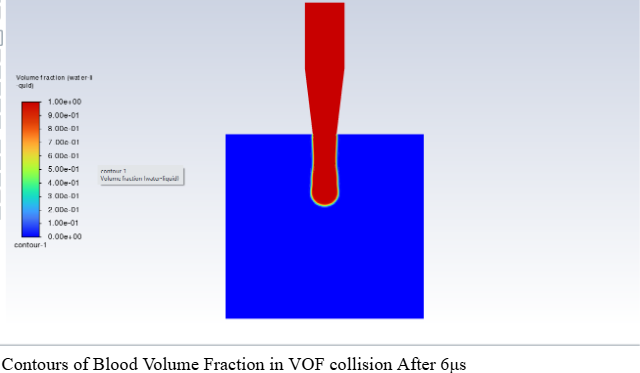
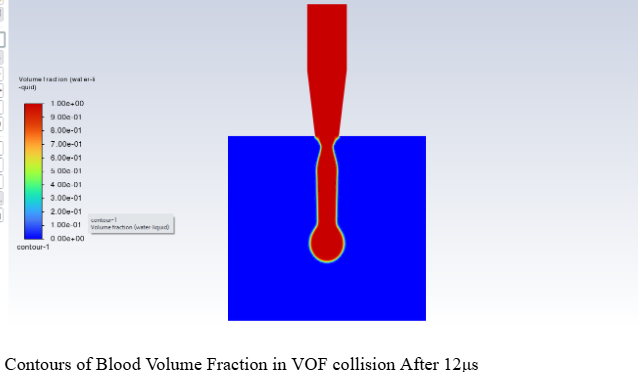
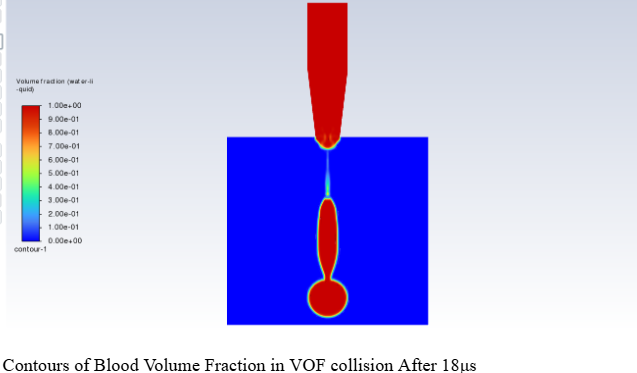
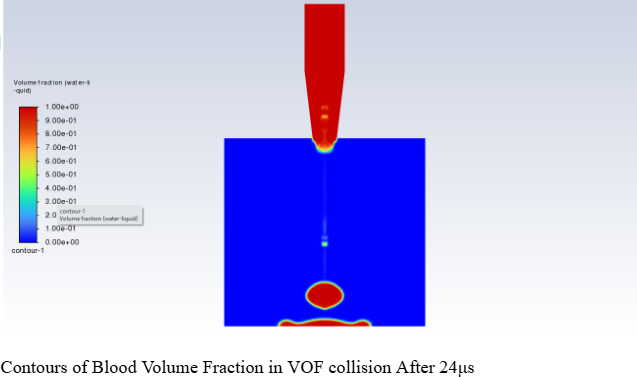
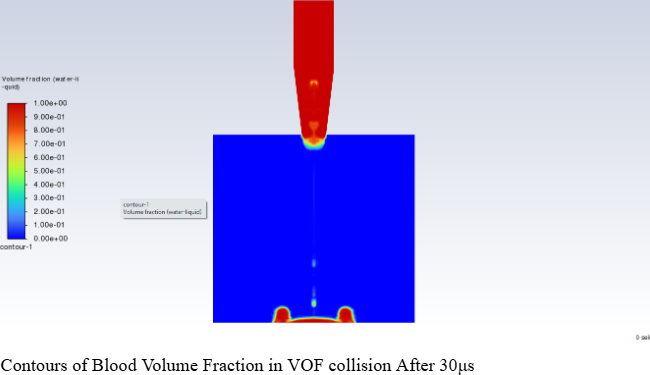
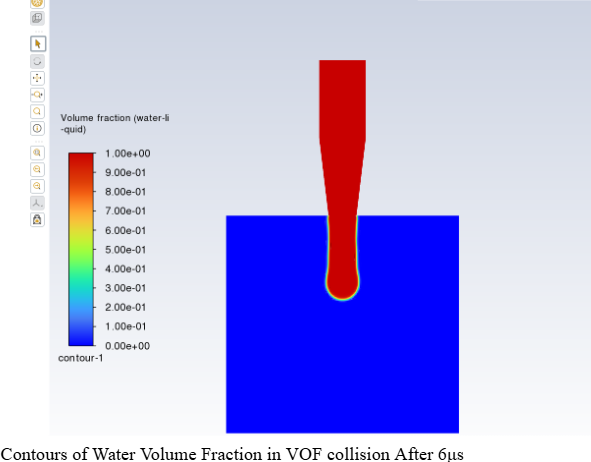
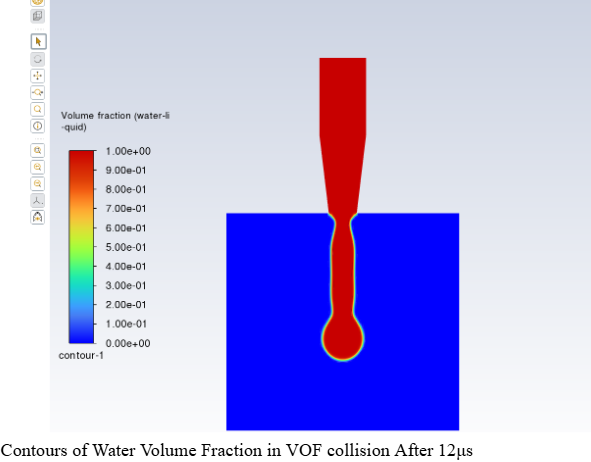
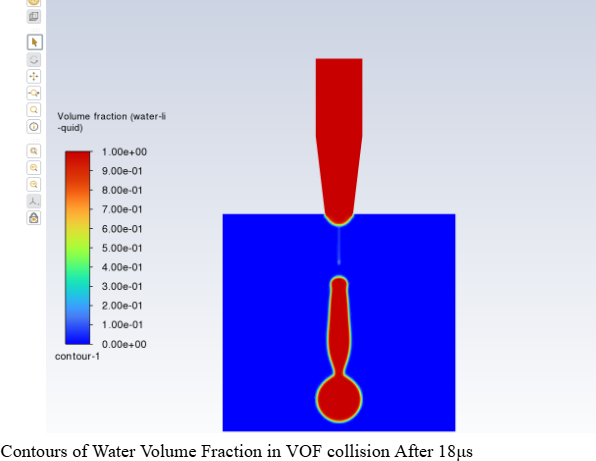
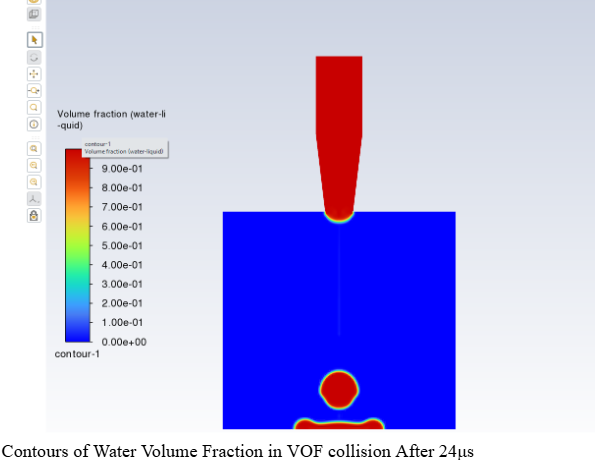
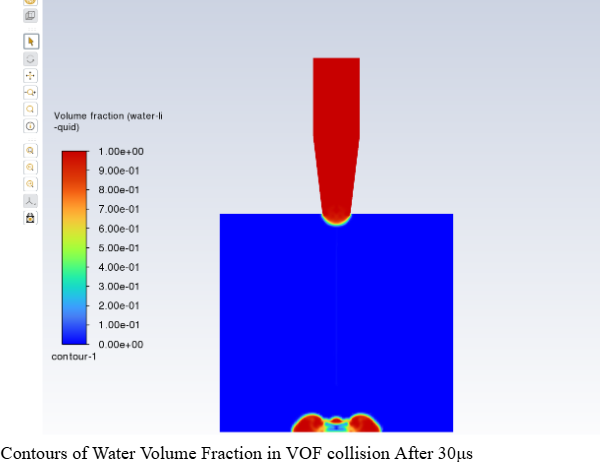
Contours of Blood and Water Collision from 6µs to 30µs
Results
What the Contours Show
The volume fraction contours show the full droplet timeline: liquid leaving the nozzle, droplet formation, travel through the chamber, and impact/spreading on the opposite wall. Comparing water vs. blood highlights how fluid properties change droplet shape and breakup.
Water vs. Blood Comparison
- The largest differences appear during droplet formation at the nozzle exit and during wall impact, especially when the first droplet hits the wall and the next droplet follows behind.
- Compared to water, the blood case shows a more stretched/elongated shape as it exits the nozzle. This is consistent with blood’s non-Newtonian viscosity (Carreau–Yasuda), which can increase the effective viscosity in lower-shear regions and delay breakup.
- After impact on the no-slip wall, the blood case tends to spread differently than water. In the contour image, this shows up as a flatter or more extended liquid region at the wall at the same time step.
Takeaway
This project demonstrates transient multiphase CFD skills in ANSYS Fluent, including VOF interface tracking, surface tension effects, wall impact behavior using no-slip boundaries, and extending the model with a UDF to simulate non-Newtonian blood flow.